

Over the past five years, I’ve been researching strategy and leadership, and over the last year and a half, I've been sharing articles about that research as I’ve developed it. I have now brought it all together into a holistic system I’m calling Choose, Lead, Be Seen.
This article sets the tone for what I write from here on.
Each issue will now be short and built on that system: three ideas from me, two findings from other people’s research, and one question for you. The three ideas will always be of the same three kinds. One on choosing what to work on. One on leading people to deliver it. One on making sure the work is seen.
It should take two minutes to read. The format is James Clear’s 3-2-1, used with thanks.
Longer articles will appear when a subject needs it. This is the first of those, and its job is to set out the system and show where it comes from.
Three questions
So, what does five years of research come down to?
Three questions.
Are you working on the right thing?
Can you get it done through other people?
Does anyone who matters know it was you?
I call them Choose, Lead and Be Seen. Each rests on its own body of research: a PhD on how firms choose their strategy, a framework of 234 leadership practices, and more recent research on why good work goes unnoticed.
My sense is that the three multiply. Strength in two does not make up for weakness in the third. I believe this is why capable people can sometimes stagnate, and it happens in three ways:
Lead and be seen, without choosing. The team is busy, the numbers are on target, and you are praised for work the business would not miss. Praise is what makes this one so hard to leave.
Choose and be seen, without leading. You saw what mattered but did not deliver. You were right, and people acknowledge that, but you couldn’t capitalise on it.
Choose and lead, without being seen. The right thing, done well. Somebody else was given the next job, and you were told you are too valuable where you are.
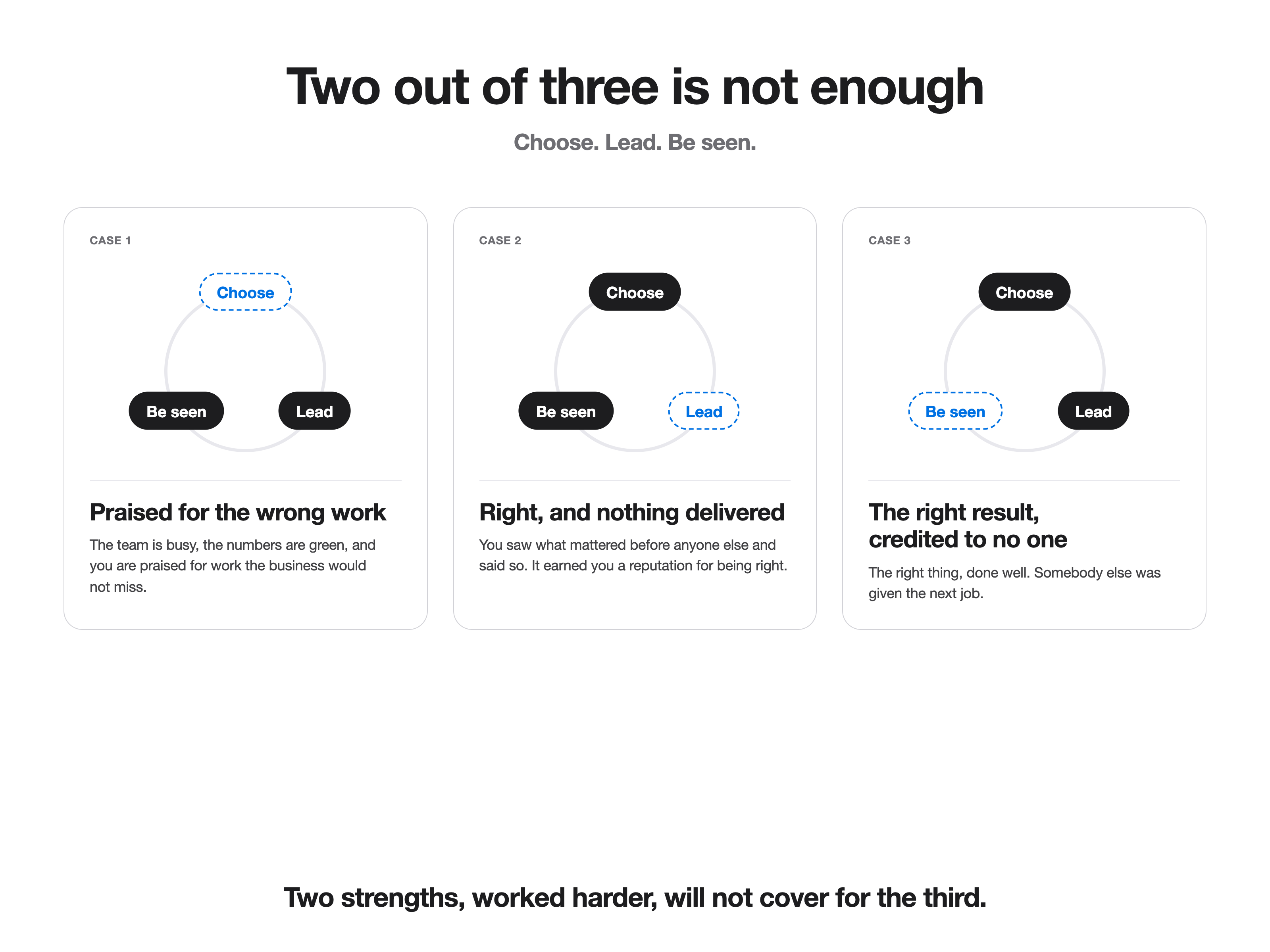
Each of these feels like a different kind of bad luck. I think they are one mistake. We take the two things we are good at and work harder at them, hoping they will cover for the third.
Choose: start with what is changing
For my PhD I screened 8,430 firms to find the ones that had come to dominate their markets. There were eleven.
What separated them was where their strategy began. Most firms start inside, with what they are good at, and look for somewhere to use it. The eleven started outside, with what was changing in the world, and built themselves around a small number (three or four) of those changes.
One change is a bet, and if it slows you have nothing else. Ten is a list, and nobody inside or outside the firm can say what you are for. Three or four gives you a position that is hard to copy, because a competitor has to match you on all of them at once.
To make that usable I catalogued the changes themselves. There are 292, drawn from the academic literature and sorted into five forces: society, power, innovation, nature and economy.
The method is called Thematic Strategy, and I have set out the research in full. It asks a firm to see which changes matter, pick the three or four to build around, and then build the capabilities that become more valuable as those changes gather pace.
You do not need to run the firm to use it. Your function has a strategy whether or not anyone has written it down, because its strategy is where its hours and its budget go.
So write down the three or four changes that will matter most to your business over the next five years. An ageing customer base, say. Artificial intelligence. Tighter climate regulation. Then write down where your function’s hours and budget are allocated, and lay the two lists side by side.
Where they match, you are building something that will be worth more every year.
Where they do not, the work that fails the test is probably work you are good at, and work you are thanked for. That is what makes it hard to stop. Stop it anyway. No amount of effort later will rescue it.
Lead: a skill you can learn
A Choice doesn’t translate to results until other people carry it out.
There is no shortage of advice on how to make that happen, and most of it is right. “Build trust.” “Communicate the vision.” “Empower your team.” The trouble is the level it is pitched at. None of it tells you what to do when you sit down with someone in a one-to-one.
So the second body of research is built from the ground up. It has five domains: leading yourself, judgement, direction and execution, people and teams, and influence and change. Those divide into fifteen disciplines, the disciplines into 78 behaviours, and the behaviours into 234 practices.
A domain tells you where to look. A practice tells you what to do.
Feedback shows how that works. Avraham Kluger and Angelo DeNisi pooled 607 results covering 23,663 observations of feedback at work. On average, feedback improved performance. In more than a third of cases it made performance worse.
The difference was attention. Feedback worked when it kept a person’s attention on the task, and worked less and less well the further it pulled that attention towards themselves, their standing and their worth.
So before you give feedback, check the subject of your sentence. “You are unreliable” has the person as its subject, and there is nothing they can do with it except defend themselves. Say this instead.
“The report was due on the 4th and arrived on the 9th. What happened?”
That makes the work the subject, and work can be put right.
The framework holds 234 practices at that level of detail.
Be seen: work cannot speak
This is the stage too many people skip, often on principle.
In the late 1990s, Thomas Gilovich and two colleagues at Cornell asked students to put on an embarrassing T-shirt and walk into a room of their peers. Afterwards, the wearers estimated how many people had noticed.
They said 46%. The real figure was 23%.
We are noticed about half as much as we believe, and that was for something very visible. Quiet, competent work does not even have the advantage of being embarrassing.
The argument is that reliability makes this worse. The more dependably you do something, the less anyone registers that you did it. It stops being an achievement and becomes “her job”, or “just what he is like”. The better you are, the faster you turn into furniture.
You might be thinking, “Good work should speak for itself, and I have no wish to become someone who sells.”
You are right to dislike the selling, and the people who have to listen to it dislike it too. Ovul Sezer, Francesca Gino and Michael Norton set a plain statement of achievement against the same claim wrapped in false modesty. In one experiment, the straightforward version persuaded 86% of students to sign a petition, and the humblebrag persuaded 65%.
So the research agrees with you about the performance. It disagrees with you about the silence.
Work cannot speak. People speak about it in meetings you are not in, and they can only repeat what they have been given. So give them one sentence. Say which part was yours, as a fact, and stop.
“I rebuilt the forecast. Month-end now takes five days. It used to take nine.”
My research sets this out in four steps. The work:
has to be noticed, so you show it;
has to be understood, so you explain what it took;
has to be valued, so you claim your part; and
has to stay known, which means doing all three again, because memory is short.
This will feel uncomfortable the first few times. Do it anyway. Until the work is seen, it is not finished.
A virtuous cycle
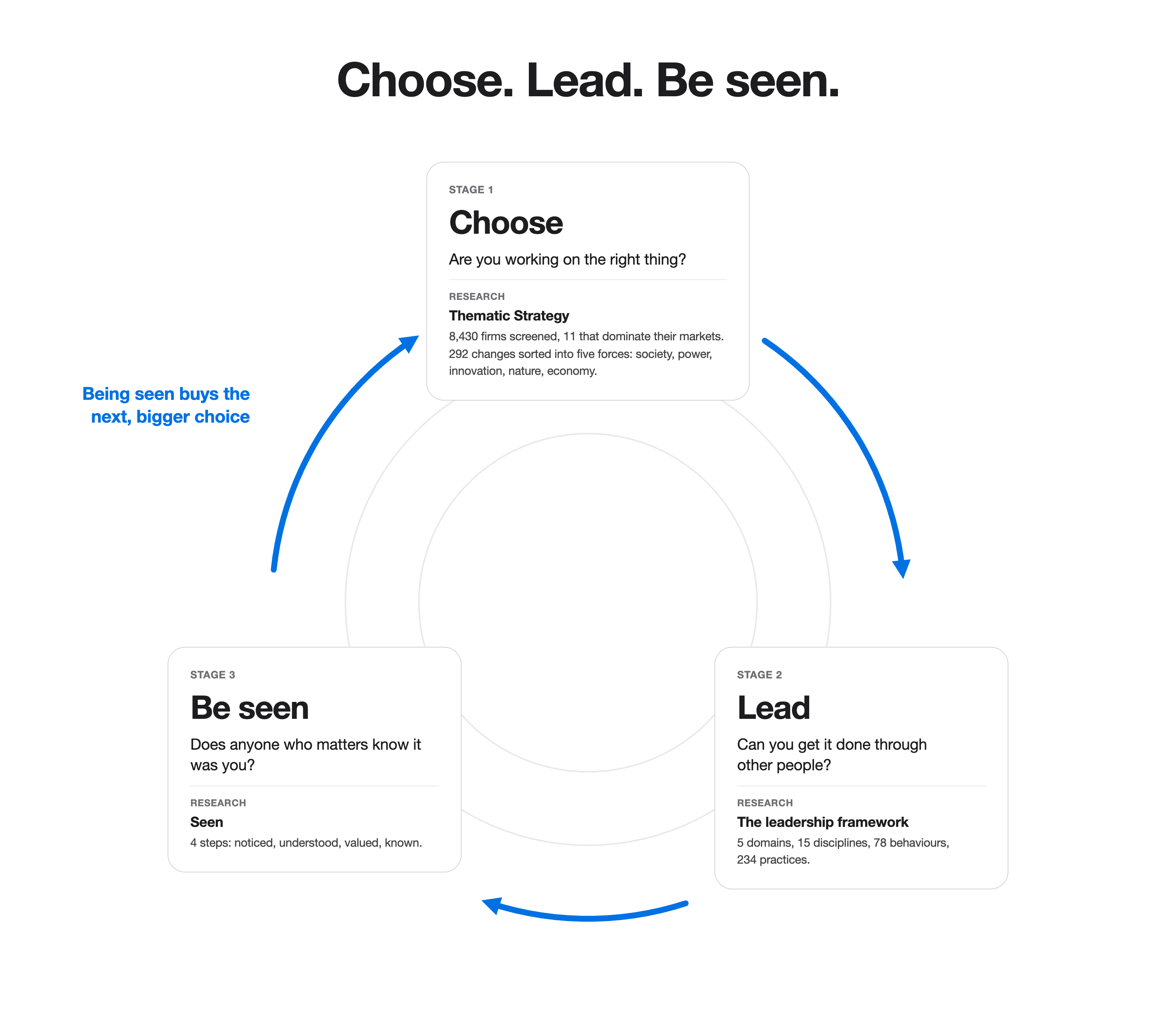
The three stages run in a loop.
The larger remit, the budget and the invitation to help set strategy are all handed out by people acting on what they know about you. Give them more to know, and the choices you are trusted with get bigger.
Then you go round again with more at stake. You are choosing for a division where you once chose for a function. The leading is harder, because you are now leading leaders. Being seen is harder too, because the people who need to see you expect more of you.
Find your missing third
You probably know which of the three you are best at. It is the one you reach for when things get difficult.
Finding the one you neglect takes ten minutes. Score each of these from 1 to 5, where 5 means you could prove it to a sceptic.
Choose. The business would still miss my function’s three biggest pieces of work a year from now.
Lead. When I am away for two weeks, the work slows down, but nothing stops.
Be seen. The person who decides my next role could say, in one sentence, what I did this year.
If Lead is your lowest, there is a full assessment at leadersofthepeople.com.
Whichever it is, start there. It will be the one you least want to work on, which is how it became the lowest.
From next Saturday, everything I send will contain three ideas from me, one for each stage, two findings from other people's research, and one question for you. Two minutes to read.
Until next week,
Ian Hallett
p.s. Here is a longer and less polite look at how you lead.
Join Me
Thanks for reading. Each week I share 3 short ideas from me, 2 findings from others, and 1 question for you. Thousands of people subscribe. Click the button below to sign up.
I love these three pillars and I’m excited to continue to follow along and share this series! The three elements form a self-reinforcing triangle, which I’ve used as a visual in much of my mentoring for leaders. Thanks for continuing to share your learnings!