

This article is part one of a five-part series that explains the Leadership Operating System I developed earlier this year as a post-doc project.
The research aimed to codify leadership into learnable practices. From it, I created an assessment tool that gives you a forensic reading of how you lead. Give it a go.
On 9 October 2014, eight months into the job, Satya Nadella sat on stage in Phoenix at the Grace Hopper Celebration, a conference for women in computing. Maria Klawe, who sat on Microsoft’s board, asked what he would say to women who are uncomfortable asking for a pay rise.
He said that not asking might be “one of the additional superpowers” of women who don’t ask. “Because that’s good karma.”
Klawe disagreed with him there and then, in front of the audience.
As chief executive, Nadella had nobody above him to tell him what to do next. Whatever happened in the following hours, he had to lead himself through it. Later that day he emailed Microsoft’s staff (fast, for a chief executive’s apology), and in it he wrote:
“I answered that question completely wrong.”
He backed Klawe’s advice and said he had learned a lesson. Five years later, Klawe called the episode “one of the best things that ever happened for Microsoft.”
So what does leading yourself actually involve, and can you practise it like any other part of the job?
What leading yourself covers
In 1991, Susan Ashford and Anne Tsui published a study whose title would do as a definition of this domain: self-regulation for managerial effectiveness. They studied 387 managers, rated by 2,447 of the people who worked around them, and looked at how each manager sought feedback on their own performance. Managers who asked for negative feedback were rated more effective. Managers who went looking for praise were rated less effective.
Bradley Owens, Michael Johnson and Terence Mitchell came at it from another direction. Across eight samples, they found that expressed humility predicted performance over and above conscientiousness and general mental ability, and that teams led by humbler leaders lost fewer people.
Both studies judged leaders through other people’s eyes. Leading yourself happens privately, but the people around you see the results and rate you on them.
In the Leadership Operating System, Leading Self is the first of five domains. It covers how you regulate your own emotion and conduct under pressure, how you learn from experience and feedback, and how you stay open to being wrong. Those are its three disciplines: composure and self-regulation, learning and adaptability, and humility and candour.
It comes first because the other four domains depend on it. Judgement under pressure depends on composure, and you cannot develop anyone else if you cannot take feedback yourself.
If you keep one thing from this piece, keep this:
Your team works with your habits every day, so leading yourself is the first thing you do for them.
My sense is that capable people neglect this domain because nothing in their career so far has required. Results got you promoted. Nobody appraised your composure, or asked how often you changed your mind in public. At the next level, people notice those things.
By the end of this piece, you will have three questions to check yourself against, and a working list of the fifteen behaviours behind them.
Three questions to lead yourself by
The self-check has three questions, one for each discipline. Run it in writing after any moment that tested you, and once a week on the week as a whole.
Was I calm when it mattered?
What did I learn, and what will I change?
Where was I wrong, and did I say so?
The first is about composure. It asks what you actually did when the pressure arrived: the sharp reply, or the meeting you cut short. If you stayed calm, write down how, because you can use that method again.
The second is about learning. Knowing what you would do differently is the easy part. Once you run something, nobody else is going to arrange your learning for you.
The third is about candour. It asks whether you have said the thing out loud: the admission, the credit to someone who was right when you were not, or the difficult point the person concerned has not yet heard from you.
A finished self-check can be this short:
Cut Priya off when she questioned the forecast, sharper than I meant. At the next forecast review, I take challenges last and answer each one in full; Priya will see it. The growth assumption was mine, and it was weak. I have not told her that yet.
Each question draws on one discipline, and each discipline has five behaviours.
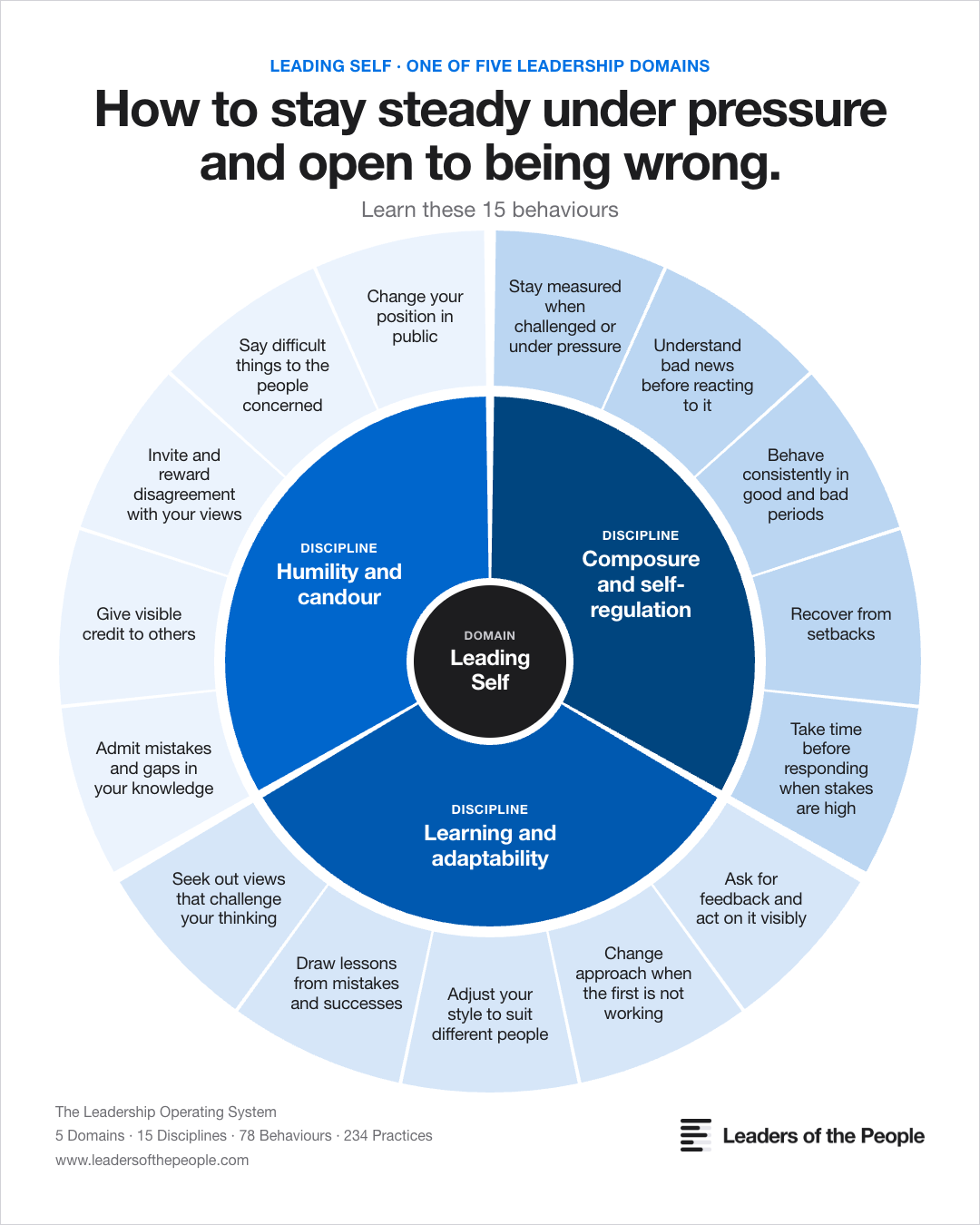
Composure: leading yourself under pressure
Composure is choosing how you behave before you feel calm enough to. Your team checks it every time they bring you something difficult.
Stay measured when challenged or under pressure. When the pressure has come from above, tell your team in one plain sentence what it is and what it means for them, before they read it from your manner.
Understand bad news before reacting to it. Spend the first thirty seconds on three questions: what exactly happened, what do we know for certain, and what do you need from me now.
Behave consistently in good and bad periods. Ask two of your direct reports, separately, what they check before bringing you something. If either mentions your mood, you have found the inconsistency.
Recover from setbacks. Decide when, later the same day, you will think the setback through, and park it until then so it does not follow you into unrelated meetings.
Take time before responding when the stakes are high. Buy the time in one sentence that says when you will come back, and then keep to it.
I have written before about the first sentence after a challenge. Composure will get its own article later.
Learning: leading yourself through experience
Experience does not turn into learning by itself. Something in your week has to force the lesson out, and this discipline is a set of small routines that do the forcing.
Ask for feedback and act on it visibly. Ask one person one specific question about one thing you did, and within a fortnight tell them what you changed.
Change approach when the first is not working. Before you start, write down what would tell you the approach has failed, and by when.
Adjust your style without moving your standards. Keep a short written list of the standards everyone is held to. Anything not on it is style, and can vary by person.
Draw lessons from mistakes and successes. After any work that mattered, write four answers: what we set out to do, what happened, why the difference, and what I will do differently.
Seek out views that challenge your thinking. Before you defend a firm position in public, state the best argument against it well enough that the person who holds it would accept your version.
The fourth is worth doing for successes too, because a success is where the wrong lesson is easiest to draw.
Candour: leading yourself when you are wrong
This is the discipline Nadella was practising that day. Admitting your own mistakes is what earns you the right to name other people’s.
Admit mistakes and gaps without prompting. Start with what you did, not why you did it. Then say what you will do about it, and stop.
Give visible credit. Name the people who did the work in every report that goes upward or outward. Make it a rule of format, so it does not depend on remembering.
Invite and reward disagreement. Ask what is wrong with a proposal before asking whether people agree, and wait until you have heard two objections.
Say difficult things to the people concerned. Nothing about someone’s work goes to a third party until it has gone to them.
Change your position in public. When the better argument arrives, say in the same meeting that your view has changed, and whose argument changed it.
For the first, the sentence is short:
“I set the wrong deadline. Here is what I am doing about it.”
Humility and candour will get its own article too.
Four ways capable people neglect it
Waiting for the appraisal. The annual review becomes the only feedback you get on yourself. By the time it arrives, whatever it describes has been running for a year.
Steady on good days. Composure that holds when the numbers are fine and slips when they are not. The team learns to check your mood before bringing you anything, which means bad news reaches you later.
The private lesson. You learn, and you change, and nobody is told. The team goes on working around the old version of you, because the old behaviour is the only evidence they have.
Self-criticism. We replay the meeting at night, go over what we should have said, and call it reflection. It feels like leading yourself and changes nothing anyone else can see. A lesson that never reaches your behaviour has done nothing for your team.
Nadella, played back
Go back to that day and run the self-check.
Was he steady when it mattered? The instinct after a public mistake is to explain what you meant. His email led with the admission instead.
What did he learn, and what will he change? He said he had learned a lesson, and offered to take questions on it at his monthly staff Q&A. The email does not say what he would do differently, which is the part his staff would have been watching for.
Where was he wrong, and did he say so? Plainly, in one sentence, and he backed the advice of the board member who had disagreed with him.
Two of the three answered well, inside a few hours.
You might be thinking, “My job is to lead the team, not to work on myself.”
That is fair, and an hour a week of reflection that changes nothing would be wasted. Each behaviour is something you do in a meeting or a one-to-one you were holding anyway.
Nor does any of it need a different personality. You do not have to enjoy criticism to ask for it.
One limit. If you treated someone badly, that is a conduct matter: put it right with them directly before you review anything.
Check yourself against the last week
How sure am I? The research behind the domain is reasonable: the feedback finding comes from 387 managers rated by the people around them, and the humility finding held across eight samples. The three questions are my arrangement of practices that are widely used and consistent with that research. Nobody has tested this particular self-check. If something shorter did the same job, I would use it.
Run the three questions on the past week now, in writing, three lines each.
Then take the question where your answer was weakest, pick one behaviour from that discipline’s five, and do its action once before the week is out.
Take this away
The tool: The self-check, three questions to lead yourself by, one for each discipline.
Ask: “Was I steady, what did I learn and change, and where was I wrong and did I say so?”
Do this week: Run the self-assessment, and practise one behaviour from your weakest discipline.