

This article is part five of a five-part series that explains the Leadership Operating System I developed earlier this year as a post-doc project.
The research aimed to codify leadership into learnable practices. From it, I created an assessment tool that gives you a forensic reading of how you lead. Give it a go.
Paul O’Neill ran Alcoa from 1987 to 1999, and from the start he made worker safety the company’s priority. His son later shared his father’s view: “It’s not OK if anyone ever gets hurt at work.”
By the time he left, lost-workday incidents at Alcoa had fallen from 1.86 to 0.2 per 100 workers, according to a Harvard study. The company made a profit in 11 of his 12 full years in charge, and its workforce grew from about 48,000 to more than 140,000.
George Becker, a former president of the United Steelworkers, said of him in 2001: “I always felt O’Neill had a concern and sensitivity for working people.”
O’Neill could not order 140,000 people to be careful, and he could not watch them all (he had a huge company to run).
So how does a leader get people he does not manage to change how they work, and keep them changing for twelve years?
Understanding Influence and Change
When Gary Yukl and Bruce Tracey studied 128 managers, rated by 526 of their subordinates, 543 peers and 128 bosses, they looked at which ways of asking produced real commitment to a task. Rational persuasion, inspirational appeals and consultation came out best. Pressure, building a coalition and appealing to your authority came out worst.
How you ask determines whether people commit to the work or only comply with it.
David Herold and his colleagues looked specifically at change. They studied how leaders’ behaviour related to employees’ commitment to a change, and found that a leader’s vision and inspiration mattered more than change-management technique, most of all when the change hit people personally. But where people did not see their leader as inspiring, good change-management practice still raised their commitment.
That second finding is helpful for everyone: good practice still helps when inspiration is missing.
In the Leadership Operating System, Influence and Change is the fifth of five domains. It covers how you set out a direction people recognise as worthwhile, how you win support from people you cannot instruct, and how you change the routines and structures that produce results. Its three disciplines are vision and communication, influence and stakeholders, and leading change and shaping systems.
This is the domain where authority runs out. As you move up, more of what you need sits with peers, senior people and other teams, none of whom report to you. The habits that worked with your own team, deciding and telling, start to cost you.
If you keep one thing from this piece, keep this:
A change has not happened until the weekly routine is different.
By the end of this piece, you will have three conversations to hold before you announce anything, and a working list of the seventeen behaviours behind them.
Three conversations before you do anything
Before any change you want people to adopt, hold three conversations, in this order.
The picture: where we are going, and what it means for you.
The objector: the person most likely to resist, first and alone.
The routine: which activity, report or rule has to change.
The first is vision. Say it to one person who will be affected, in a paragraph, and include what will be different for them. If they cannot say it back, rewrite it before anyone else hears it.
The second is influence. Take the proposal to the person most likely to oppose it, before anyone else, and ask what is wrong with it. Change what should change. Whether or not they come round, they will have been heard first.
The third is change. Agree with whoever owns it which routine, report or rule will be different on the first day. If you cannot name the routine that changes, you have an announcement and no change.
For the second conversation, the opening is short:
“I wanted you to see this before anyone else. What is wrong with it?”
Each conversation draws on one discipline, and between them the three disciplines hold seventeen behaviours.
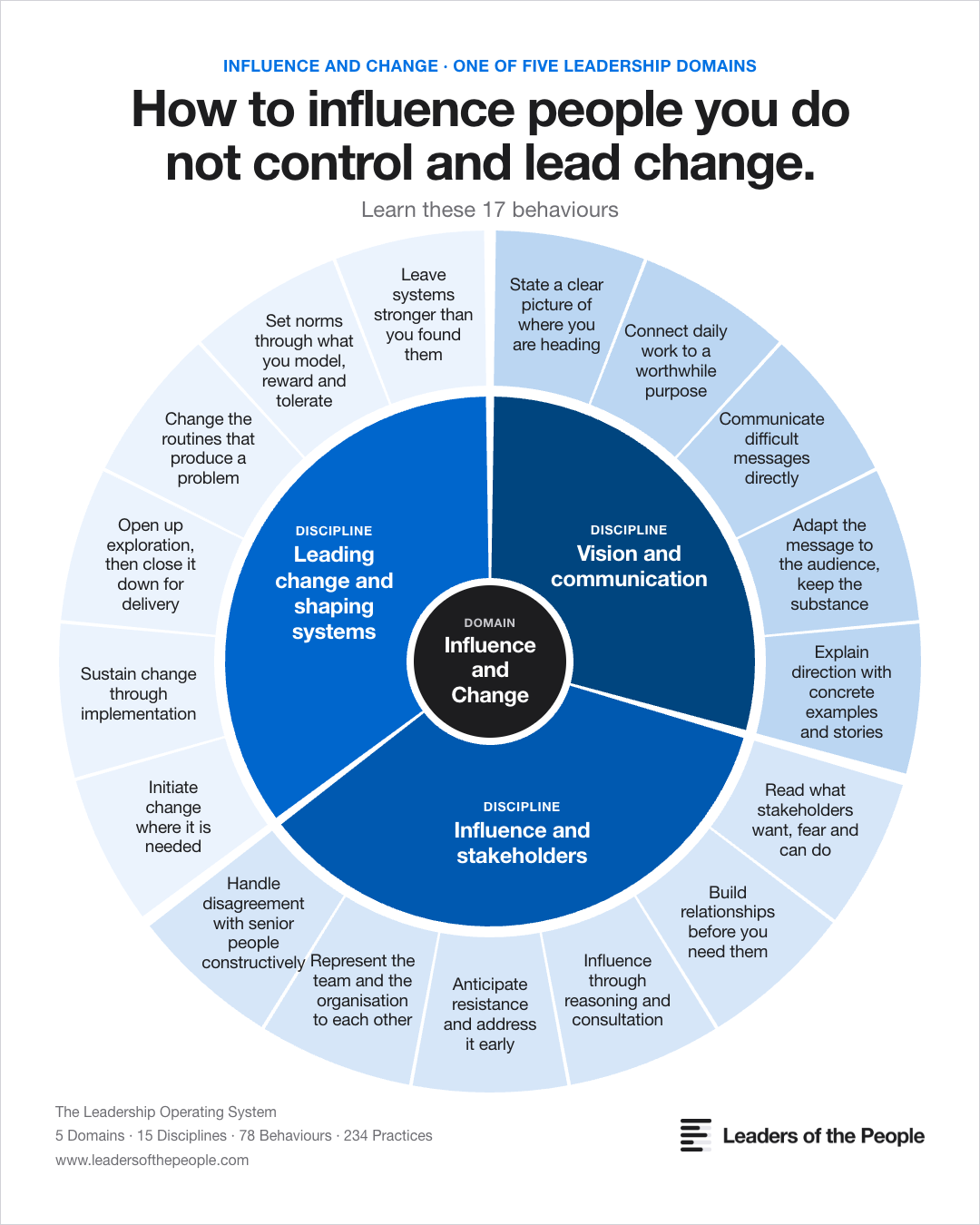
Vision: saying where you are going
A direction people cannot repeat is a direction they cannot act on. The test of a vision is whether someone two levels down can say it back, and say what it means for their own work.
State a clear picture of where you are heading. Write it in one paragraph that a new joiner could say back in their own words.
Connect day-to-day work to a purpose. Once a week, tell someone how a specific piece of their routine work helped someone.
Communicate difficult messages without spin. Put the difficult message in the first two sentences, then stop and take questions.
Adapt the message to the audience, keeping the substance. Write the substance in three sentences, then check that each audience’s version still contains all three.
Use concrete examples and stories. Each time you hear yourself say “excellence” or “agility”, replace it with one real example from your own team.
The third is where trust is won or lost. People listen to the opening of a difficult message for what is being hidden, and if the hard part is in it, they can hear the rest. Vision and communication will get its own article in the discipline series.
Influence: winning support you cannot order
This discipline has six behaviours. The relationships that help you in a crisis are the ones you built before you needed them.
Read what stakeholders want, fear and can do. Before you meet someone you need to influence, write down all three. If you cannot, find out first.
Build relationships before you need them. Have one conversation a week with someone in another part of the organisation from whom you need nothing.
Influence through reasoning and consultation. Ask how they see the problem before you propose your answer, and change the proposal where they are right.
Anticipate resistance early. List who will resist and why, in their words, before you present anything.
Represent your team and the organisation to each other credibly. Give the same account of a decision upward and downward: the same reasons, costs and uncertainties.
Handle disagreement with senior people constructively. Push back once, with your reasoning, then say what you will do to carry out their decision.
The sixth is where capable people often go wrong in one of two directions, repeating the argument until it becomes a fight or not making it at all. Once, clearly, is enough. Influence and stakeholders will get its own article.
Change: making it stick
Starting a change is the easy part. This discipline is about the long middle of a change, where the launch has faded and the deadline is still far off.
Initiate change where it is needed. Keep a list of what should change that nobody has asked you to change, and start one item each quarter.
Sustain change through implementation. Set as many milestones for the middle of a change as for its launch, and report progress every fortnight, including when nothing moved.
Open up exploration, then close it down. Tell the team whether a piece of work is exploring or delivering, and set the date on which exploring ends.
Change the routines that produce a problem. When the same problem appears a third time, change the routine or incentive behind it.
Set norms through what you model, reward and tolerate. At the end of each month, list what you let pass that fell below standard, and address the one that matters most.
Leave the system stronger than you found it. Once a year, write down what the unit can do now that it could not when you arrived, and would still do if you left.
I have written before about the third time a problem appears. Leading change and shaping systems will get its own article.
Four ways capable people get this wrong
Launch and leave. The announcement gets the energy, the slides and the all-staff email. The middle gets nothing, and the team concludes the change has been dropped some weeks before you do.
The pressure play. We reach for the deadline, the senior name or the meeting stacked in advance, because it is quicker. In Yukl and Tracey’s study, pressure was among the tactics least likely to produce commitment.
The slogan. A direction made of abstract words, with no example attached. People nod, and nothing they do changes, because nothing told them what to do differently.
The surprise. The strongest objection is first heard at the meeting where you present. Resistance you discover in the meeting is obstruction; the same resistance discovered a week earlier is information.
Alcoa, played back
Run O’Neill’s twelve years through the three conversations, from the outside.
The picture was simple enough for anyone to repeat: nobody gets hurt at work. It applied to every person in the company, from the plant floor up, and it was a purpose anyone could recognise as worthwhile.
We do not know whom O’Neill spoke to first. We do know that a former president of the United Steelworkers later spoke of his concern for working people. That is what support from someone you cannot instruct sounds like.
O’Neill also changed the structure, giving plant managers more decision-making power. A fall from 1.86 to 0.2 lost-workday incidents per 100 workers takes changed routines, sustained for years.
You might be thinking, “I’m not running a company. I can’t change routines that other people own.”
That is fair, and the scale is different. But the three conversations work at the size of a team. One paragraph about where your team is going, one conversation with the peer most likely to object, and one routine in your own area that changes on the first day.
One limit. If you would give a different account of the change to different audiences, what you are doing is managing perceptions, and people find out.
Plan the three conversations
Pick one change you want to make in the coming months, and write three lines: the picture, the objector’s name, and the routine that will change.
Then hold the conversation with the objector before the week is out.
Take this away
The tool: Three conversations before you announce anything: the picture, the objector, the routine.
Ask: “I wanted you to see this before anyone else. What is wrong with it?”
Do this week: Write the three lines for one change, and speak to the objector first.
And then go to Leaders of the People and assess your own skills.
Loving the way you are building this...very systemically....nicely done Ian