

This article is part two of a five-part series that explains the Leadership Operating System I developed earlier this year as a post-doc project.
The research aimed to codify leadership into learnable practices. From it, I created an assessment tool that gives you a forensic reading of how you lead. Give it a go.
When Steve Jobs returned to Apple in 1997, the company was trying to support 15 product lines. In the year before his return, it had lost $1 billion on revenues of $7.1 billion.
He cut the range to four: a desktop and a portable Macintosh, each with a professional version and a consumer version. Printers went. So did the Newton, Apple’s handheld computer.
In his first full year back, Apple earned a profit of $309 million. Its revenue had fallen to $5.9 billion.
So Apple returned to profit while selling less. What had changed was what the company was trying to do, and what it had stopped paying for.
Understanding Direction and Execution
When Anders Skogstad and his colleagues surveyed 2,273 employees about leaders who avoid leading, they found that laissez-faire leadership was a major problem. When leaders are more hands-off, people reported more uncertainty about their role, more conflict between the demands on them, and more bullying.
Edwin Locke and Gary Latham’s review of 35 years of research, covering more than 40,000 participants in eight countries, found that specific, hard goals produced better performance than being told to do your best.
When a leader says nothing about what matters, the team gets less clear and less effective.
In the Leadership Operating System, Direction and Execution is the third of five domains. It covers
How you make goals, roles and priorities clear
How you make sure commitments are delivered
How you put time, people and money behind what matters most.
Its three disciplines are clarity and structure, accountability and delivery, and prioritisation and resourcing.
My sense is that this is the domain capable operators think they have already mastered, because it is what got them promoted. You delivered. The difficulty is that until now you delivered mostly through your own effort, and at the next level that stops working.
The question changes from whether you can get it done to whether your team gets it done when you are not watching.
By the end of this piece, you will have a weekly half-hour with three questions, and a working list of the fifteen behaviours behind it.
The weekly half-hour
Thirty minutes with your team, at the same time each week, with three questions and nothing else on the agenda.
What are we trying to achieve, and what wins when things conflict?
What did we say we would do, and is it done?
What are we stopping or moving to make room?
The first question gives clarity. The second enforces accountability. And the third sets priorities.
A week’s answers can be this short:
Trying to achieve: renewals first, new customers second. Done: three of five; the pricing paper is late and Sam has a new date. Stopping: the monthly dashboard nobody reads, which frees two days for renewals.
Each question draws on one discipline, and each discipline has five behaviours.
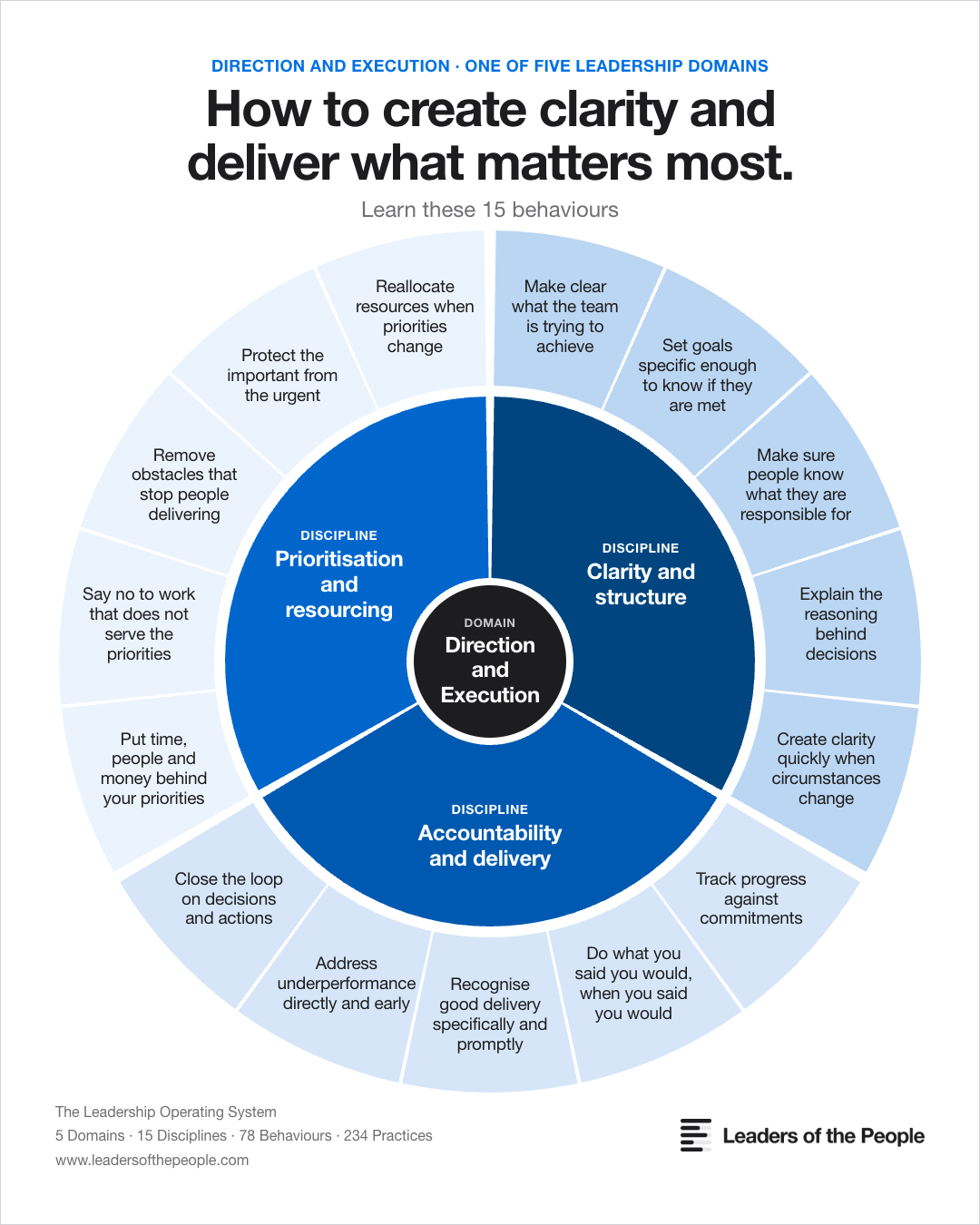
Clarity: deciding what matters
Clarity is what your team uses when you are away. A priority is only clear if someone can use it to choose between two pieces of work without asking you.
Make clear what the team is trying to achieve. Rank the priorities in writing, three or four at most, so that the ranking settles it when two pieces of work clash.
Set goals specific enough to check. Rewrite each goal until a stranger could say at the end whether it was met: what, how much, by when, measured how.
Make sure people know what they are responsible for. Write down who owns what, read it to each person, and ask them to say it back in their own words.
Explain the reasoning behind decisions. Give the reason with every instruction, in the same sentence or the next.
Create clarity quickly when circumstances change. Within a week of any change, restate the ranked priorities in writing, saying what changed and what did not.
The fourth matters more than it looks. The reason is what lets someone do the right thing when the situation changes and you cannot be asked. Clarity and structure will get its own article in the discipline series.
Accountability: making sure it gets done
Accountability that depends on you chasing people stops whenever you are busy. This discipline is about building follow-through into the team’s routines, so that it carries on without you.
Track progress against commitments. When you hand work over, agree two checkpoint dates with the person, and do not look between them.
Do what you said you would, when you said. Write your own promises down before the conversation ends, and if you are going to miss one, say so before the date.
Recognise good delivery specifically and promptly. Within the week, tell the person what exactly was good and why it mattered.
Address underperformance directly and early. Raise the first instance within a week, in private, with what happened and what you expected instead.
Close the loop. End every decision with who does what by when, and open the next meeting by reading those actions back.
The second applies to you before anyone else, because the team holds itself to the standard you keep. I have written before about raising underperformance at the first instance, and accountability and delivery will get its own article.
Prioritisation: paying for what matters
Prioritisation is where clarity gets paid for. The test of a priority is whether time, people and money moved when you named it.
Put time, people and money behind your priorities. Once a month, set your ranked priorities beside where your own time and the team’s budget actually went.
Say no, or not now. Give requests that do not fit a dated “not now”, and keep a list of what you deferred.
Remove obstacles. Ask in every one-to-one what is in the way that you could remove, and remove at least one thing a week.
Protect the important from the urgent. Book time for the important work before anything else goes in the diary.
Reallocate when priorities change. Before you announce a new priority, name what it takes resources from: which people move, and what stops.
When the request comes from above, the “not now” becomes a question about the trade-off:
“I can do this if the upgrade slips by a month. Is that the right call?”
I have written before about naming the casualty when you take on new work. Prioritisation and resourcing will get its own article.
Four ways capable people get this wrong
The everything priority. Ten priorities, all marked high. The team works out its own ranking, usually by whoever asked last or loudest, and it is not the ranking you would have chosen.
The add-on. New work announced on top of old, with nothing moved and nothing stopped. The extra capacity comes from people’s evenings, and the team knows it before you do.
The green report. Every status update says on track until the week it says late. If you only ask whether things are on track, you will hear yes until it is too late to help.
The heroic finish. We see a deadline slipping and fix it ourselves, late at night. It works, it feels like leadership, and it teaches the team that dates are soft because you will catch whatever falls. Each time you rescue a deadline yourself, the reason it slipped goes unfixed.
Apple, played back
Run Apple’s 1997 through the three questions, from the outside.
What was Apple trying to achieve? Four products: a desktop and a portable, each for professionals and for consumers. Anyone could hold a new proposal up against that grid. The grid answered the first and third questions at once, for everyone in the company.
What was Apple stopping? Printers and the Newton. That is the third question answered.
What did Apple say it would do, and was it done? From outside we cannot see the internal follow-through. We can see the result: a $1 billion loss turned into a $309 million profit within a year, on lower revenue.
You might be thinking, “My team is senior. They don’t need this much structure.”
That is fair, and senior people do not need checking between agreed dates. But they still need to know what wins when two priorities clash, and what has been stopped, and they cannot work that out on their own. Skogstad’s findings are about what happens when nobody tells them.
The half-hour covers the ranking, the commitments with dates and the stops, and nothing else. A full status review belongs in a different meeting.
Hold the half-hour with your team
Before your next team meeting, write your own answers to the three questions.
Then put the half-hour in the diary for the same time every week, and hold the first one with your team before the week is out.
Take this away
The tool: The weekly half-hour, three questions on what matters, what is done and what stops.
Ask: “What are we stopping or moving to make room?”
Do this week: Write your answers to the three questions, then hold the first half-hour with your team.
And then go to Leaders of the People and assess your own Delivery and Execution skills.