

This article is part four of a five-part series that explains the Leadership Operating System I developed earlier this year as a post-doc project.
The research aimed to codify leadership into learnable practices. From it, I created an assessment tool that gives you a forensic reading of how you lead. Give it a go.
In 2009, a team at Google set out to answer a question the company had argued about since it was founded: do managers matter? The team expected to show they did not (engineers were sceptical of management).
They failed. Project Oxygen drew on exit interviews, staff surveys, performance reviews and interviews with managers at both ends of the ratings, and concluded that managers did matter and found eight things the best ones did.
First on the list was “is a good coach”. Second was “empowers the team and does not micromanage”. Third was “expresses interest in and concern for team members’ success and personal well-being”.
Last, in eighth place, was having the technical skills to advise the team.
So if expertise got you promoted, what makes people do well when working for you?
Understanding People and Teams
David Garvin, who wrote up Project Oxygen for Harvard Business Review, also reported what happened next. Google fed the eight behaviours back to its managers through upward surveys. Between 2010 and 2012, managers’ median favourability scores rose from 83 to 88 per cent.
Michael Frazier and his colleagues came to the same conclusion from the team’s side. Their meta-analysis of 136 samples and more than 22,000 people looked at psychological safety, the shared sense that it is safe to speak up. Safety was closely associated with role clarity and support from colleagues, and safety in turn went with learning behaviour.
The behaviours that make people do well for a manager can be measured, and managers can learn them.
In the Leadership Operating System, People and Teams is the fourth of five domains. It covers
How you support and respect the people who work for you
How you develop their capability and their freedom to decide
How you create a team that can think, disagree and perform together.
Its three disciplines are support and respect, developing and empowering, and building team conditions.
My sense is that this is the domain capable operators find hardest to put first, because their expertise is what got them promoted. Being the person with the answer feels like doing the job well. At the next level, the useful question is how many people on your team could give that answer instead of you.
If you keep one thing from this piece, keep this:
The test of this domain is what your team can do when you are not there.
By the end of this piece, you will have four questions for your next one-to-one, and a working list of the fifteen behaviours behind them.
Four one-to-one questions
Four questions for one-to-ones with your team. They take about ten minutes.
What pressure are you under right now?
Which decision should be yours, not mine?
What feedback do we owe each other?
What is the team not saying?
The first is support. Ask it before any work item, and wait for the answer. Remember what you hear, and ask about it next time.
The second and third are development. The second hands over a decision, which develops someone faster than advice does. The third runs both ways, and you go first: say one thing you would do differently in how you managed them, then ask for theirs.
The fourth is about the team. People will often tell you privately what nobody will say in the team meeting, and the fourth question is the way in.
A finished one-to-one can produce four short notes:
Pressure: her father is in hospital; move the regional review back a fortnight. Decision: she signs off supplier changes under £20,000 from now on. Feedback: I rewrote her slides without asking, and she would like the first draft back with comments. Not saying: two people think the new rota is unfair and have not raised it.
Each question draws on one discipline, and each discipline has five behaviours.
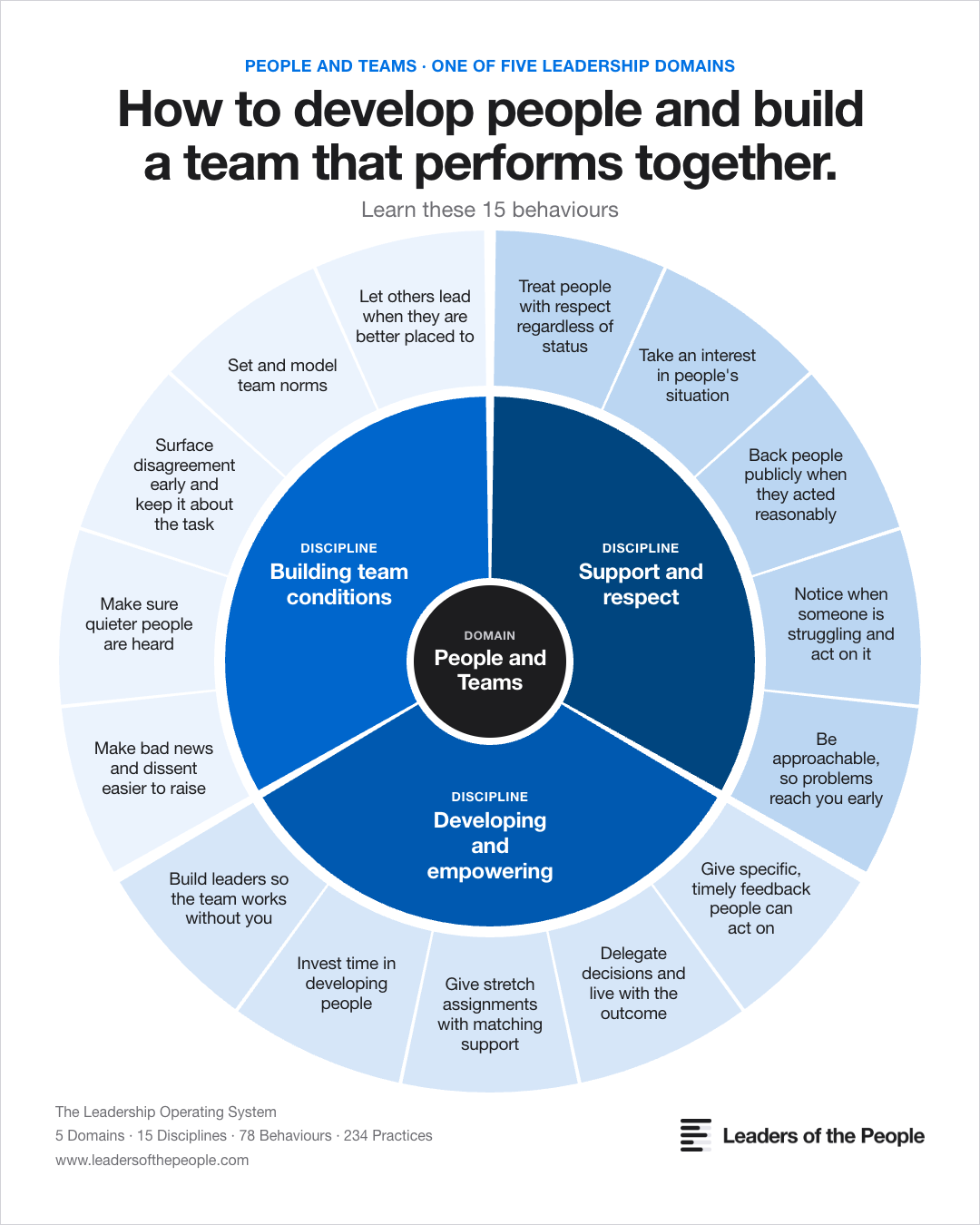
Support: treating people well
Support is the discipline people notice in small things, such as whether you remember their name and follow up. Support includes the difficult conversation, because a hard truth you hold back reaches the person later, from someone less kind.
Treat people with respect regardless of status. For a fortnight, give the most junior person in each meeting the attention you would give the most senior: a follow-up question, and their name when you use their point.
Take an interest in people’s situation. Be able to name the three main pressures on each of your direct reports, at work or beyond it, without looking anything up.
Back people publicly when they acted reasonably. When a reasonable decision has a bad outcome, say in the meeting where it is being judged that they did what you would have done.
Notice when someone is struggling, and act. Watch for a change from their normal, ask privately the same day, and do one concrete thing about it within the week.
Be approachable. Thank whoever brings you the first small problem, and deal with it quickly, so the next one reaches you while it is still small.
The third is the one the whole team watches. Backing given in the meeting protects the person, and everyone else learns from it. Support and respect will get its own article in the discipline series.
Development: making people more capable
Development is mostly a matter of what you hand over. Every decision you keep that someone on your team could make is a lesson they do not get.
Give specific, timely feedback. Within two working days, say what you saw and the effect it had, then ask for their view.
Delegate decisions, and live with the outcome. Write down which decisions each person makes without asking you, and give them the list.
Give stretch with matching support. Give an assignment one size too big, tell them it is a stretch, and agree a checkpoint in the first week.
Invest time in developing people. Book a fortnightly slot for one person’s development, and protect it as you would a client meeting.
Build leaders so the team works without you. Take a week away without naming a deputy, and treat whatever waited for your return as the development list.
The second is where most delegation fails. When a delegated decision goes a way you would not have chosen, and it was within the bounds you set, let it stand. Developing and empowering will get its own article.
Team conditions: making it safe to speak
A team performs together when people can raise problems, disagree and be heard, whoever they are. Those conditions are set by how you respond, one conversation at a time.
Make bad news and dissent easier to raise. Your first words are thanks for raising it, your second a question about it, and only then your response.
Make sure quieter people are heard. Ask one person who has not spoken for their view, by name, and then use what they say.
Surface disagreement early, and keep it about the task. Name it the first time you see it.
Set and model team norms. Agree three norms with the team, write them down, and when you break one, say so in front of them.
Let others lead when they are better placed. For each new piece of work, ask out loud who is best placed to lead it before you take it yourself.
For the third, the sentence is short:
“I think you two see this differently. Can we hear both?”
I have written before about how to get people to disagree with you and how to hear bad news early. Building team conditions will get its own article.
Four ways capable people get this wrong
Kindness without standards. Warm one-to-ones and no hard feedback. People like working for you and do not get better, and the first time they hear the truth is in a performance review.
The kept decision. The task is delegated and the decision stays with you. The person does the work and waits for your view, and learns that their judgement is not wanted.
The rescue. Someone brings you a problem and you solve it. We do this because it is quicker and we are good at it. The person comes back with the next one.
The loudest voice. The same three people speak in every meeting, and you take their view as the team’s. The quieter people stop offering their view, and what they know stays with them.
What Google did next
Google turned the eight behaviours into upward surveys and gave managers their scores. Garvin reports that the lowest-scoring managers improved the most, especially in coaching and career development, and gives the example of one vice president, Sebastien Marotte, whose favourability score rose from 46 to 86 per cent within two survey cycles.
Play the four questions against the top of Google’s list. The first is the interest in people’s well-being. The second is empowering without micromanaging. The third is coaching. The fourth is listening, which Google folded into being a good communicator.
Google’s evidence was that managers who scored badly on these behaviours could change, and fairly quickly.
You might be thinking, “My expertise is what I’m here for. If I stop using it, what am I for?”
That is fair, and Google kept technical skill on its list. Use your expertise, but use it to ask the better question rather than to give the answer. A manager who knows the work can coach it far better than one who does not.
None of this means agreeing with everyone, or never deciding. Delegation has bounds you set, and a team where people can disagree still needs someone to close the discussion.
Use the questions in your next one-to-one
Take the four questions into your next one-to-one, and write down one note against each.
Then act on the answer to the second question before the week is out: hand over the decision.
Take this away
The tool: Four one-to-one questions, covering support, development and the team.
Ask: “Which decision should be yours, not mine?”
Do this week: Use the four questions in one one-to-one, and hand over one decision.
And then go to Leaders of the People and assess your own skills.