

During my three-year doctoral programme, I spent thousands of hours studying why a small number of companies seem to dominate their markets. A pattern became impossible to ignore: the vast majority of companies build strategies exactly the same way everyone else does, except the market leaders.
Here’s the uncomfortable truth I arrived at through my research:
Your strategy will fail if it’s built the way most firms build theirs.
And most firms start in the same place: with ego-driven ambition.
Leaders decide what they want:
to be the best
to be the biggest
to be the fastest
or whatever goal sounds impressive in the moment
This thinking feels strategic. It isn’t.
It produces generic strategies that look interchangeable across an industry.
If you start with internal ambition, you will always lean toward the same priorities, the same initiatives, and the same blind spots everyone else has. That’s why so many strategies sound identical: growth, efficiency, innovation, scale. The usual suspects.
And none of it works.
What I Learned: Distinctive Strategy Must Come From the Outside
Through my research, I found that a truly distinctive strategy begins somewhere completely different.
Instead of starting with internal ambition, start with 3–4 external drivers of transformation. These are large-scale forces reshaping society, technology, and the economy — forces no single company can control, but every company must respond to.
Drivers like:
artificial intelligence
climate and environmental pressure
crypto and decentralised systems
geopolitics and shifting power structures
To name just four.
When you anchor your strategy in themes of this magnitude, something important happens: your organisation stops reacting to the latest trend and starts aligning itself with the forces shaping the future.
Now ask yourself:
What kind of strategy would you build if your entire business were designed around these drivers?
It wouldn’t look anything like your competitors’.
It wouldn’t be a collection of disconnected initiatives.
It wouldn’t lean on generic ambition or vague aspiration.
It would be distinctive by design.
And that’s the foundation of Thematic Strategy — the strategic operating system.
The Essence of Thematic Strategy
When I talk about Thematic Strategy, I’m not referring to a single tool or a collection of disconnected ideas. It’s a complete system - one I developed over a three-year doctoral programme studying the world’s most successful firms, including Apple, Microsoft, and Gilead Sciences.
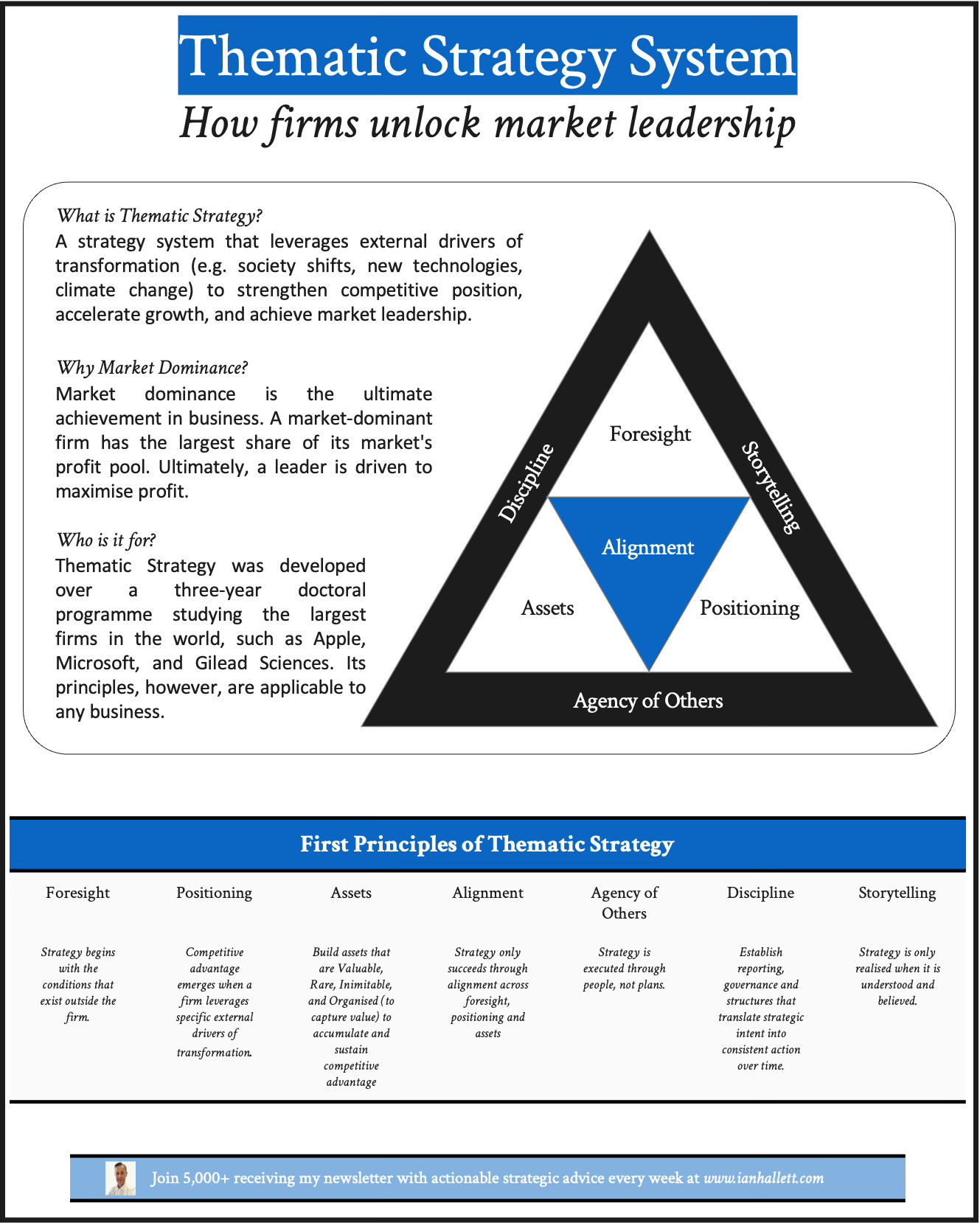
At its core, Thematic Strategy explains how firms unlock market leadership by aligning themselves with the external forces shaping the future. The framework in the diagram breaks this system into three levels:
The central mechanisms (Foresight, Positioning, Assets)
The core (Alignment)
The enablers (Agency of Others, Discipline, Storytelling)
Here’s how each element works.
Foresight: Strategy Begins Outside the Firm
Foresight is where strategy starts.
It forces leaders to look beyond internal ambition and examine the external drivers of transformation — societal shifts, new technologies, regulatory change, geopolitical tension, climate pressure, and more.
Foresight answers one question:
What conditions are reshaping the world?
Without this, strategy becomes guesswork. With it, strategy becomes anchored in reality, not in ego or wishful thinking.
Positioning: Compete Where the Future Is Going
Positioning comes next:
If foresight tells leaders what’s changing, positioning tells them where they should play.
A firm only gains a meaningful advantage when it leverages specific external drivers. It stops copying competitors and starts building where others aren’t looking.
Great positioning is always:
distinctive
intentional
anchored in future drivers, not present industry norms
This is where firms begin to separate themselves from the market.
Assets: The Engine of Competitive Advantage
Assets are the foundation. They are what actually make advantage possible.
But they must meet four criteria:
Valuable — they solve real problems
Rare — not widely possessed
Hard to Copy — earned over time
Organised to Capture Value — the firm is structured to use them
The firms I studied that achieved market dominance did so by building up assets that competitors couldn’t replicate.
Alignment: The Centre of Everything
Strategy only works when foresight, positioning, and assets align.
If they point in different directions, the entire system collapses.
Alignment ensures that:
I’m using the right assets
to reinforce the right positioning
driven by the right external themes
This is what turns strategy from a document into a force multiplier.
Agency of Others: Strategy Is Executed Through People
A strategy doesn’t live inside a plan. It lives inside people.
Agency of Others means shaping the behaviours, decisions, and actions of the people who will execute the strategy: employees, partners, suppliers, and customers.
If people don’t carry the strategy forward, it never leaves the page.
Discipline: The System That Protects Momentum
Discipline is the operating rhythm - the governance, reporting, and structures that convert intent into consistent action.
Without discipline:
strategy becomes episodic
progress becomes optional
priorities drift
The firms that win establish systems that enforce the strategy as a continuous activity.
Storytelling: Where Strategy Becomes Belief
Storytelling is often misunderstood. It’s about meaning, not marketing.
A strategy only takes hold when people understand it, believe in it, and can repeat it.
Storytelling:
explains why the themes matter
clarifies the firm’s direction
creates internal alignment
builds external momentum
A strategy without storytelling is invisible.
Apply the learnings from this article: Click here to download the Thematic Strategy Canvas to create strategies the way market leaders do.
How It All Fits Together
The inner three triangles are the strategic pillars where the strategy lives: Foresight, Positioning, Assets.
The outer triangle represents the mechanism that drive behaviour: Agency of Others, Discipline, Storytelling.
The internal triangle represents Alignment, which keeps the system coherent.
When these components reinforce one another, firms unlock the potential for market leadership. But not through ambition, but through structure.
This is Thematic Strategy.
It’s how firms stop guessing, stop copying, and start leading.
Thank you for your insights Dr. Hallett.
I went through this post yesterday in detail and it was beautiful timing as I'm working with my team now on defining a strategy. This work allowed me to pause a bit and think about how to factor in those external transformation drivers (e.g. AI) - that we had been previously overlooking. We were so internally focused on our organization / team. But this now challenges us to really think about how we can set ourselves apart from others.
Liked also the storytelling concept. It gives leaders an opportunity to talk about the "why" which could help give everyone that intrinsic motivation that propels teams.
Great article Dr. Hallet. — and I appreciate how it challenges conventional strategy thinking.
What stood out to me most is the idea that strategy shouldn’t be built around internal ego-driven goals (like simply being “bigger” or “faster”), but instead anchored in external forces of disruption shaping the future — such as AI, climate change, and geopolitical shifts. By starting from the outside in, leaders can create a distinctive strategy that isn’t just a rearrangement of what everyone else is doing.
Are you applying these concepts in your organisation ? What are the challenges do you face in real time?
Sincerely,
Saurav Mohanty