

When the agreed work is not done, it is tempting to blame the team’s discipline or the managers’ grip. My argument in this article is that the outcome depends heavily on three things the leader does after the decision is made:
Makes clear what is expected
Follow up on whether it happened
Puts time, people and money behind it
None of the three needs charisma, and all of them can be learned.
What does the evidence say?
The first two of those behaviours have strong research behind them.
The first question is whether basic follow-up matters as much as inspiring people. When Timothy Judge and Ronald Piccolo pooled 626 correlations from 87 sources in 2004, they compared the two directly. One was the inspiring kind of leadership, which they call transformational. The other was the basic business of saying what is expected and recognising it when it is delivered, which they call contingent reward. On a scale where zero means no link with results and one means a perfect link, transformational leadership scored .44 and contingent reward .39 (essentially no difference). This means follow-up after a decision counts almost as much as inspiration during it.
The second question is whether the wording of the goal makes a difference. Edwin Locke and Gary Latham reviewed 35 years of goal-setting research, covering more than 100 tasks and over 40,000 people in eight countries. Specific, difficult goals outperformed “do your best” by a large margin. So how a decision is defined and specified changes how much gets done after it. “Deliver the new system to all three sites by March” gives people something to aim at and something to check against.
The third behaviour, putting resources behind the goal, has thinner evidence. Intel shows what a team does when its leaders say one thing and fund another.
A brief story about Intel
In 1984 Intel was a memory chip company. It had helped create the market, and Japanese manufacturers were taking it away. Over the following year profits fell from $198 million to under $2 million. Its stated strategy was still memory chips. Intel also made microprocessors, and introduced a new one, the 386, in 1985, but it was not yet clear whether that business could carry the firm.
Imagine being a production manager there that year. Factory capacity is scarce, memory chips are losing money, and microprocessors look the better use of what capacity you have. You decide each week what to produce, and the sensible answer keeps coming out the same.
Robert Burgelman later traced Intel’s exit from memories in a comparative study of its memory and microprocessor businesses. He found that middle managers, making exactly those routine decisions, had shifted manufacturing capacity from memories to microprocessors before the corporate strategy officially changed.
So when Andy Grove asked Gordon Moore in 1985 what a new chief executive would do if the board threw them out, and Moore said he would leave memories, the two of them were confirming a change their own managers had already made. They then did it themselves, and more than 7,000 people, almost a third of the workforce, lost their jobs.
This is important: Intel’s managers were executing all along. Their weekly allocation decisions favoured microprocessors while Intel’s stated strategy remained memory chips, and for a while Grove and Moore did not act on the difference. Intel was fortunate that microprocessors turned out to be the right bet. Managers making the same sensible weekly decisions could just as quietly have moved capacity to the wrong product.
Your team is executing something every week. The question is whether it is what you said.
By the end of this article you will have three handovers to check, and the words to use at each. They correspond to the three disciplines of Direction and Execution, one of the five domains of the Leadership Operating System I developed from my post-doctoral research. Between them, the three disciplines cover fifteen behaviours you need to learn:
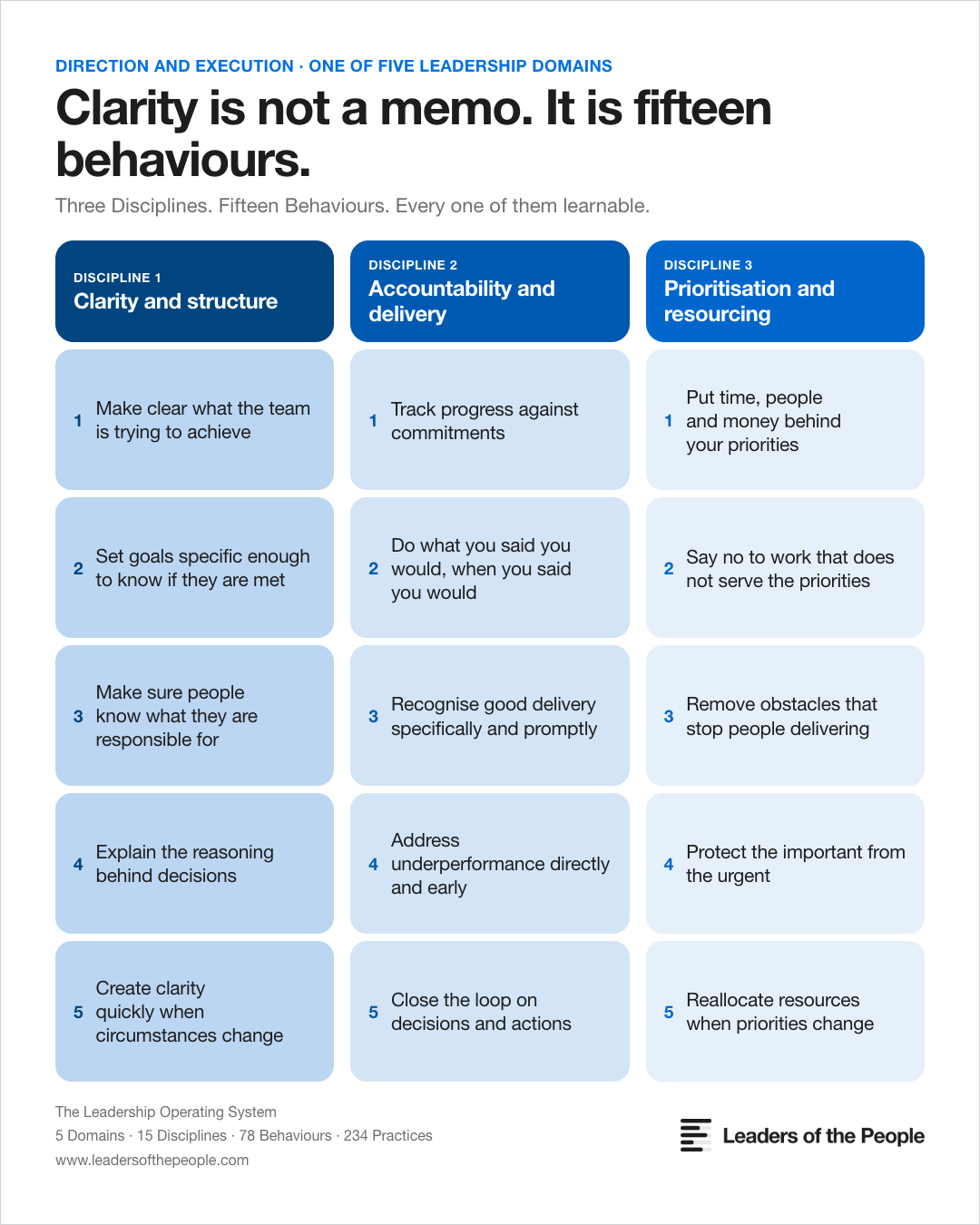
Getting it delivered
Between your decision and the delivered work, someone has to hand it on three times, and it can be dropped at each.
1. From you to the people three layers down. Anders Skogstad and his colleagues surveyed 2,273 employees and found that leadership which leaves people to alone to execute a decision is associated with role ambiguity (r = .45) and role conflict (r = .42). In a team, role ambiguity looks like people guessing at what matters and being told afterwards that they guessed wrong.
The check is to ask three people at two levels below you. Ask them separately, so that nobody can borrow another person’s answer:
“What is this unit trying to achieve this year, and which part of it is yours?”
If the answers are unclear, or come back as your slogan with nothing else, rewrite the goal until it can be answered, then ask again. A usable answer names something measurable and a piece of the person’s own work.
2. From the decision to the person who owns each action. Before any decision is made, every action agreed in it needs one named owner and a date. Build one place where the whole team can see every commitment and its status, such as a board or shared page, and have owners keep it up to date. Then open each review meeting the same way:
“What did we agree last time, and where does each item stand? Which ones are late, and what do you need from me?”
A status report is worth little until bad news is safe to put on it, so the first time someone reports red, thank them in front of the others. If an item is late twice, ask the owner what is in the way before asking when it will be done.
3. From your announcement to whoever controls the time, people and money. This is the Intel handover, and the person who controls the resources may well be you. When a leader announces one priority and funds another, people believe the funding. Once a month, write your top three priorities in rank order, count the hours you gave each one in your calendar, and note where your strongest people are working. If the top priority received the fewest hours, you have found the gap. Then move hours to it, or change the ranking. When you reprioritise, say what stops and who moves:
“To fund this, we are stopping [named piece of work], from [date]. [Name] moves across to lead it.”
Execution is not supervision
The obvious objection is that all of this sounds like checking up on people. Some of it is, and a leader who reads back actions every week will occasionally feel like a schoolteacher taking the register (the feeling passes). Supervision means the team has to ask you where things stand. In the handovers above, the owners keep the record, and you read it, and the team can see its own progress.
Nor do the handovers replace inspiration, which on Judge and Piccolo’s figures still predicts results slightly better.
Two limits. The three handovers are my arrangement of practices from the framework, and I have not tested the arrangement itself. The evidence on prioritisation is also the thinnest of the three: the framework rates it Provisional, and much of the research behind it is detailed case study of a few firms, Burgelman’s among them. I would put the third handover no more strongly than this: it is the one where the gap between a leader’s words and their spending can be counted. If you run the handovers and they mislead you, I would like to hear how.
What next?
Put one question to your leadership team at its next meeting: “If someone read our calendars and budgets for last month, what would they say our top priority was?” Ask it before anyone presents, and let the most junior person answer first.
Then do one thing today. Open last month’s calendar, count the hours against your stated top priority, and write the number down before you look at anything else.
Fund the priority first, then announce it.