

(Warning - this is a bit of a geek post):
I wrote yesterday that market dominance should be assessed by calculating a firm’s share of its industry profit pool.
To do this, we need two ingredients:
1) The industry, all the firms within it, and their profits, so we can calculate the profit pool and the share of profits for each.
2) A formula to calculate the profit share threshold for market dominance.
Let’s take each in turn.
THE INDUSTRY
For my research, I gathered data on 8,430 US-listed companies across 81 GICS industries.
I used GISC Industries as ‘the market’ because it narrows the companies to similar business activities. This allows for a more precise analysis of market dynamics because companies within each are directly comparable.
Important point: you can define industry however you like. As long as it represents a group of similar firms that sell similar products and services and compete for similar customers.
MARKET DOMINANCE FORMULA
Okay, this is the geeky part.
In their 2008 paper, Assessing Market Dominance, Arie Melnik et al. (2008) proposed a formula for calculating the market share threshold a company would need to exceed to be considered dominant.
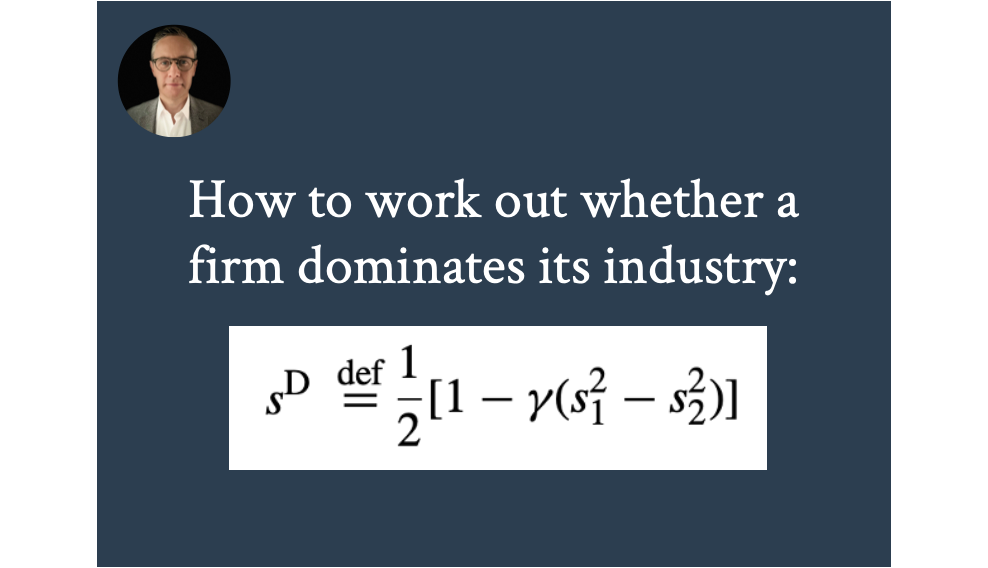
The formula compares the company with the largest market share with the second-largest market share.
It is based on the premise that the leading company in an industry becomes more dominant as the gap between it and the second-largest company increases.
Applying Melnik’s formula to the profit shares of the first- and second-largest companies in each industry identifies market dominance where it exists.
For example, in 2022, Apple’s share of profits in the Technology Hardware, Storage & Peripherals GICS industry was 82%, followed by Dell at 4%. Applying the dominance formula to the industry profit shares of Apple and Dell, the threshold for when dominance exists is calculated at just 16%. Apple clearly surpassed this.
Next, I processed the data and applied the formula to determine whether market dominance, as I defined it, existed in any of the 81 GISC Industries.
Of the 8,430 companies analysed, just 11 met the conditions for market dominance. I called them ‘Superfirms’.
I’ll share which firms they are tomorrow.
Be sure to follow me, Dr. Ian Hallett, to ensure it shows up in your feed.
This post is part of a series of notes I am writing on my PhD thesis, sharing how I approached it and what I learned.
You can see the entire series on my website.
Formula details:
sD = the market share threshold at which dominance exists
s1 = the market share of the largest company in the industry
s2 = the market share of the second-largest company in the industry
y = the relative importance of competition in the industry, where 1 is considered normal.