

Environment-driven firms.
This is the foundational concept that underpinned my PhD thesis:
“there is no single success formula which has universal validity….and the profitability of the firm is optimised when its strategic behaviour is aligned with its environment.” (Ansoff & Sullivan, 1993).
Meaning that environment-driven firms:
(1) Do not make the assumption that their markets will continue to grow and remain profitable in the future.
(2) Continually monitor the environment for signs of demand saturation, technology substitution, social and political discontinuities, and assess the future inherent profitability and growth in their historic markets.
(3) Search for and enter new areas of opportunity while they divest from unpromising markets.
It’s an integrative theory:
Environment-driven firms treat the external context as a moving reference point, acting as a feedback loop to which internal capabilities, strategic behaviours, and market choices must all adapt.
What matters is not how strategy is derived, but how well it stays aligned with environmental realities over time.
The emphasis on alignment rather than orientation reframes strategic success as a question of fit over time.
In that sense, the concept of an environment-driven firm integrates and transcends other viewpoints by treating strategy as a dynamic match between a firm’s assets and its external environment.
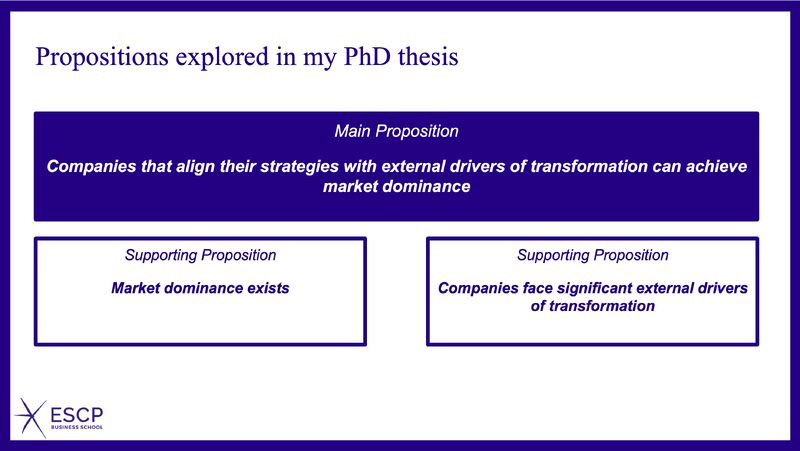
This concept led me to structure my entire PhD around a single proposition:
Companies that align their strategies with external drivers of transformation can achieve market dominance:
Intuitively, it felt right. But I needed to prove it.
I’ll share more tomorrow on how I approached it.
Be sure to follow me, Dr. Ian Hallett, so it shows up in your feed.
---
Reference:
Optimising Profitability in Turbulent Environments: A Formula for Strategic Success by H. Igor Ansoff and Patrick A. Sullivan, Long Range Planning, 1993